Trans Pride Collective Collection
When the Trans Pride Collective formed in 2023, fifteen trans pride organisations came together, joined by Manchester’s landmark trans cultural producers Trans Creative, to network, skill-share and bond. There are now 25 Trans Pride collectives and even more in the works.
Each festival has a flavour unique to its roots. Last year, the original trans pride festival in Brighton celebrated its 10th anniversary. They still manage without accepting corporate sponsorship, maintaining a relaxed, grassroots festival atmosphere. Norwich Trans Pride has a craft fair. Hastings Trans Pride is a cultural festival. Trans Pride Scotland moves location every year to reach into different communities.
History is written by the victors and captured in our community collections. They save stories of survival, resistance and celebration. By recording trans pride actions in transcestry, we pay homage to the tireless work of the volunteers who are the lifeblood of their local communities.
Trans Pride Collective
The History
I knew I wanted to mark the Museum of Transology’s ten-year anniversary with an exhibition. But at the time I was trying to conceptualise what that exhibition might look like, trans culture in the UK was under sustained pressure.
The Cass Review had been published. Government consultations were circulating proposals affecting gender recognition and access to healthcare. The Equality and Human Rights Commission had issued guidance suggesting that trans identities might not be recognised in certain interpretations of UK equality law. At the same time there had been a sharp increase in anti-trans media coverage, rising hate crime against trans people and a growing number of public debates questioning the legitimacy of trans lives in civic and cultural spaces.
Within that context I found myself hitting a creative brick wall. I wanted the exhibition to celebrate ten years of the Museum of Transology, but I was struggling to identify a curatorial idea that could offer hope during what seemed at the time to be impossibly long dark days.
Reflecting on this, I eventually realised I’d fallen into an old curatorial habit. Like many curators trained through traditional routes, I caught myself approaching the exhibition as if the role of the curator was to generate the central idea. It was the model of the curator as the ‘genius’ who arrives with the big concept when an earth-shattering bolt of lightning finally strikes and enables them to somewhat mysteriously create a profound exhibition premise that will enlighten the masses.
That model of curatorship is deeply colonial. Unlearning my own racism is a lifelong process and commitment.
Museums have historically operated through forms of authority in which curators interpret other people’s lives and cultures from a position of institutional power. Contemporary decolonial practice asks us to work differently: collaboratively, with communities and with an awareness of the limitations of institutional authorship.
Whenever I catch myself slipping back into the creative genius model, the solution is straightforward. The answer is always to do research.
So I took a step back, slowed down and started looking more closely and deeply into what was actually happening within trans communities across the UK and Ireland.
It didn’t take long to discover, plain and clear, that there was a trans cultural revolution staring me in the face. Lo and behold there were fifteen Trans Pride festivals taking place right across the UK and Ireland. These events were organised almost entirely by volunteers. Each had developed in response to the needs of its local community, creating spaces for celebration, protest, mutual support and cultural expression. They were distinct to their district, unique to their place, responding with local culture to local culture whilst engaging with national dialogue. In a commitment to the country’s diversity of culture and geography, Scotland’s Trans Pride moved location every year to engage a national trans community with distinct local communities. Ireland’s protest was deeply political, building on its own history of collective action. Norwich’s trans craft fair resonated with the city’s lasting cultural legacy of textile production.
It also seemed obvious that the organisers of these festivals would benefit from meeting one another and sharing their skills, approaches and ambitions.
So the Museum of Transology developed a project to visit each of the Trans Pride festivals across the UK and Ireland. With support from Art Fund, our community curators spent a year travelling to these events collecting ephemera— placards, posters, flyers and other materials — documenting Trans Pride culture as part of the museum’s collection and building relationships with the organisers and their communities.
Using our Art Fund grant pot, we covered travel and accommodation for a representative of every Trans Pride collective to spend the weekend in London. The trans activists travelled from across the UK and Ireland by train, plane, bus and in car shares. Most of them had never met organisers from other Trans Pride festivals before.
On the first day, we gathered at the Triangle LGBTIQA+ cultural centre and celebrated meeting each other. We sang tranny-oke, listened to trans elder guest speakers share their experiences of early trans organising, accessioned objects that each rep brought along from their hometown to add to the collection and, of course, shared tea and cake. No story is complete without tea and cake.
On the second day we took things quite seriously, writing up our collective ambitions. What purpose could our collective serve? Where to from here? And of course, we started the inevitable WhatsApp group.
Trans Pride Collective UK & Ireland was officially formed.
How did this relate to lessons we have learned from trying to access lesbian and gay history? One important principle queer historians have noted, is that the explosion of populations in urban centres in England in the late 17th and early 18th centuries resulted in a skew in historical records that centralise documentation. Police records documenting the arrest of homosexual men are more abundant in the National Archives in London, for example, though of course over recent decades queer historians committed to their local queer history have made great strides unearthing local records aplenty. The point is, heavily weighted urban documentation silences rich rural diversity and evidence of thriving queer cultures beyond the capital. These trans pride organisers were not only organising events, they were producing a rich array of deeply nuanced trans, non-binary and intersex history that needed to be documented with urgency and enthusiasm.
This was a trans cultural revolution and it needed recording. Enter the Museum of Transology’s Community Curators.
What began as fifteen festivals connecting with one another has since grown into a network of twenty-six Trans Pride events across the UK and Ireland.
The second Trans Pride Collective Assembly took place inside the Transcestry: 10 Years of the Museum of Transology exhibition at Central Saint Martins’ Lethaby Gallery. After all, it inspired it! By that point the collecting work connected to the project had also begun to generate new regional collections, which we have since catalogued and will be returned to their local areas, establishing 16 Museum of Transology collections across the UK.
Through partnerships with local museums, libraries and archives, objects connected to Trans Pride events in different parts of the UK and Ireland were added to the Museum of Transology collection. In many cases these collections now reflect the specific histories and cultures of trans communities in those places.
What began as an attempt to think about how to mark the museum’s ten-year anniversary ultimately became something much, much bigger.
The formation of the Trans Pride Collective created a network through which organisers could support one another, share knowledge and document the cultural history of Trans Pride movements across the UK and Ireland. Its very existence has played a powerful role in encouraging and supporting new, often very green, community organisers to bravely start their own Trans Pride in their own areas. There are now 26 Trans Prides— and counting.
For the Museum of Transology, this work also reinforced the central principle of the project: that trans history should be recorded in the voices of the people who are living it.
The intention to integrate trans heritage making as a principle of trans organising is an ongoing commitment that the collaboration between the Museum of Transology and the Trans Pride Collective embodies in principle. By embedding the sharing and saving of trans stories into trans organising, we learn from the mistakes we can now reflect upon that afflict the gay and lesbian pride movement— corporate oversubscription, loss of community voice to commercial constraints, festivals frequently pinkwashed and that often seem to cater to more non-LGBTIQA+ attendees than members of our own community, resulting in a need for heightened security and pricey ticketing. Embedding trans heritage into our trans pride movement adds a unique trans contribution to the historical evolution of pride organising. It means trans pride organising will always ultimately be about us, by us and for us.
With thanks to all the Trans Pride organisers who do such vitally important, exhausting work— for free— for their local communities.
Trans Pride Locations
Trans Pride Locations across the UK and Ireland, as of March 2025.
Trans Pride Birmingham, 2022.
Trans Pride Brighton, 2013.
Trans Pride Bristol, 2016.
Trans Pride Cardiff, 2019.
Trans+ Pride Cork, 2022.
Coventry Trans Pride, 2024.
Trans and Intersex Pride Dublin, 2018.
Edinburgh Trans Pride, 2024.
Trans Pride Hastings, 2023.
Trans Pride Leeds, 2017.
Trans Pride Limerick, date unknown.
Liverpool Trans Pride, 2019.
London Trans+ Pride, 2019.
Trans Pride Manchester, 2023.
Trans Pride Northern Ireland, 2018.
Trans Pride Norwich, 2022.
Notts Trans Pride, 2024.
Trans Pride Portsmouth, 2024.
Trans Pride Plymouth, 2022.
Trans Pride Scotland, 2018.
Trans Pride Southampton, date unknown.
Trans Pride Surrey, 2024.
Tower Hamlets Trans+ Pride, 2025.
Trans Pride Walthamstow, 2024.
Trans Pride Winchester, 2024.
The Collection
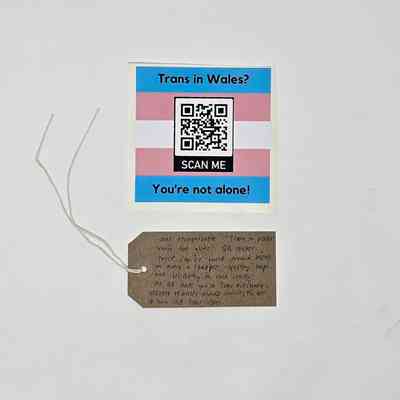
-
Square Sticker - 'Trans In Wales? You're Not Alone!' QR Code
MOT/2024/NDOTC/CARD/006
Tag our recognisable "Trans in Wales? You're not alone" QR sticker. These can be found around Wales on many a lamppost offering hope and solidarity in each county! The QR leads you to Trans Aid Cymru collated resources around surviving the cost of living and trans issues.
-
- Collection
- National Day of Trans Collecting
- Categories
- Trans Pride Collective UK & Ireland, Stickers
- Place
- Bishopsgate Institute, London
- Description
- This object was collected during the Museum of Transology's National Day of Trans Collecting and has been formally acquired by St. Fagans National Museum of History. You can find more about their museum and its collection at: www.museum.wales/stfagans/
- Dimensions
- Height 107 mm Width 108 mm Depth 1 mm

Square sticker in the trans flag colours. There is a QR code in the center and the text "Trans in Wales?" above this and "You're not alone!" below. Also, a brown hand written luggage tag
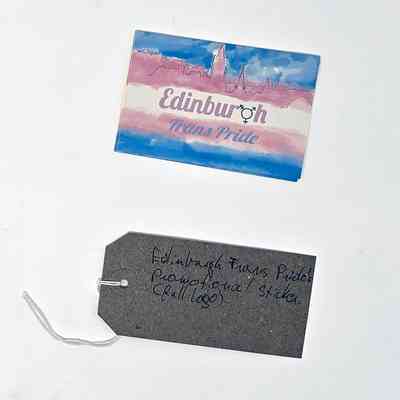
-
Sticker - Edinburgh Trans Pride
MOT/2024/NDOTC/EDIN/076
Tag Edinburgh trans pride's promotional sticker (full logo)
-
- Collection
- National Day of Trans Collecting
- Categories
- Trans Pride Collective UK & Ireland, Stickers
- Place
- Bishopsgate Institute, London
- Description
- This object was collected during the Museum of Transology's National Day of Trans Collecting and has been formally acquired by National Library of Scotland. You can find more about their museum and its collection at: www.nls.uk/
- Dimensions
- Height 65 mm Width 95 mm Depth 1 mm

Rectangular sticker with the text "Edinburgh Trans Pride" (the 'g' in Edinburgh has been replaced with the trans symbol). The background is in the trans colours with a line drawing of a city skyline. With a brown, handwritten luggage tag.
MOT/2024/NDOTC/EDIN/077
-
Stickers (x5) - Scotland Supports Trans Liberation, Trans liberation now!
MOT/2024/NDOTC/EDIN/077
Tag "TRANS LIBERATION NOW" AND "SCOTLAND SUPPORTS TRANS LIBRATION" STICKERS, 2023, EDINBURGH
-
- Collection
- National Day of Trans Collecting
- Categories
- Trans Pride Collective UK & Ireland, Stickers
- Place
- Bishopsgate Institute, London
- Description
- 2 stickers - scotland supports trans liberation 3 stickers - Trans liberation now This object was collected during the Museum of Transology's National Day of Trans Collecting and has been formally acquired by National Library of Scotland. You can find more about their museum and its collection at: www.nls.uk/

A placeholder image that is an illuminous green background and the black outline of a tag.
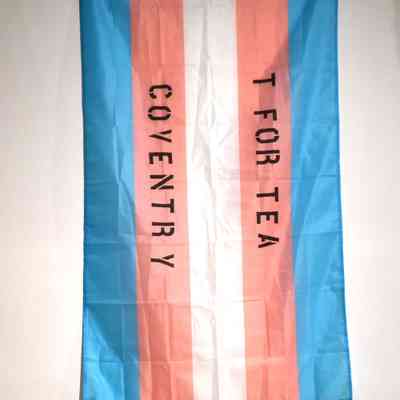
-
T For Tea Trans Flag and 5 Badges
MOT/2024/TP/COVE/001
Tag THIS IS THE BANNER WE MARCHED WITH AT BIRMINGHAM PRIDE 2024. WE RETIRED THE NAME TEA FOR T SHORTLY AFTER TO BECOME COVENTRY TRANS PRIDE.
-
- Collections
- Trans Pride Collective UK & Ireland, Placard & Banner Collection
- Categories
- Trans Pride Collective UK & Ireland, Banners, Badges
- Place
- Bishopsgate Institute, London
- Dimensions
- Height 1,524 mm Width 915 mm Depth 1 mm

-
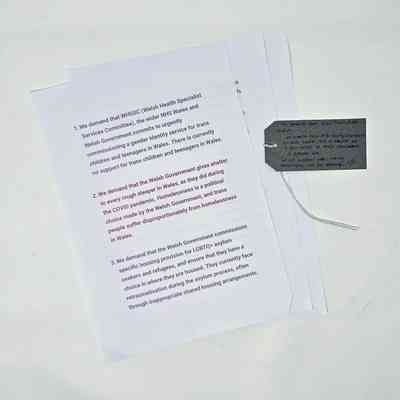
Three Pages Of Printed Demands
MOT/2024/NDOTC/CARD/024
Tag the demands from 2023 Trans Pride Cardiff. we wanted these to be easily shareable on social media, and distributed via a press release to media organisations in September 2023. we are a radical pride, and are unapologetic with our demands. TPC!
-
- Collection
- National Day of Trans Collecting
- Categories
- Trans Pride Collective UK & Ireland, Documentation
- Place
- Bishopsgate Institute, London
- Description
- This object was collected during the Museum of Transology's National Day of Trans Collecting and has been formally acquired by St. Fagans National Museum of History. You can find more about their museum and its collection at: www.museum.wales/stfagans/
- Dimensions
- Height 297 mm Width 210 mm Depth 1 mm

Three sheets of white A4 paper printed in red text with a list of demands to the Welsh Government and Heath Specialist Service Committee. With a brown handwritten luggage tag.
-
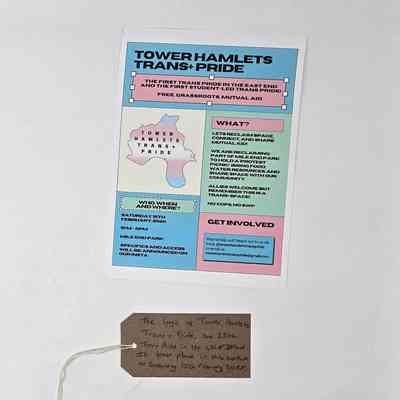
Tower Hamlets Trans Pride Leaflet
MOT/2025/TP/TOWE/002
Tag The logo of Tower Hamlets Trans+ Pride, the 25th Trans Pride in the UK & Ireland. It took place in Mile End Park on Saturday 15 February 2025.
-
- Collection
- Trans Pride Collective UK & Ireland
- Category
- Trans Pride Collective UK & Ireland
- Place
- Bishopsgate Institute, London

A blue, pink and green flyer advertising Tower Hamlets Trans+ Pride. It details information, dates and how people can get involved. With a brown, handwritten luggage tag.
-
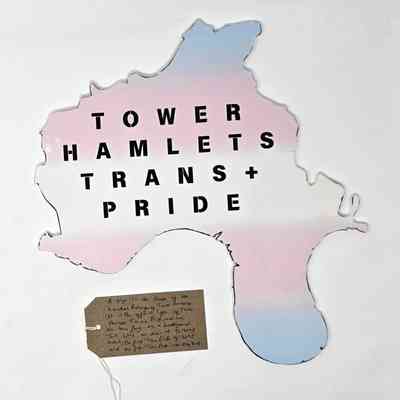
Tower Hamlets Trans Pride Logo On Foam Board
MOT/2025/TP/TOWE/001
Tag A sign in the shape of the London Borough of Tower Hamlets. It is the official logo of Tower Hamlets Trans+ Pride and has the trans flag as a background. It was on show at the 2025 event, the first Trans Pride of 2025 and the first Trans Pride in the East End.
-
- Collection
- Trans Pride Collective UK & Ireland
- Category
- Trans Pride Collective UK & Ireland
- Place
- Bishopsgate Institute, London

A foam board Tower Hamlets Trans+ Pride logo - which is the shape of the boundary of the London Borough of Tower Hamlets. It is colored in the blue, white and pink trans pride colours. With a brown, handwritten luggage tag.
-
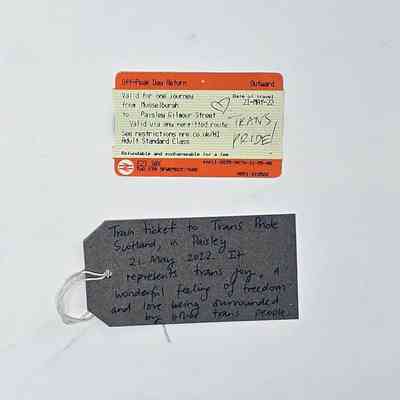
Train Ticket, Musselburgh To Paisely
MOT/2024/NDOTC/DUND/016
Tag Train ticket to Trans Pride in Scotland, Paisley 22 May 2022. It represents trans joy, a wonderful feeling of freedom and love being surrounded by other trans people.
-
- Collection
- National Day of Trans Collecting
- Categories
- Trans Pride Collective UK & Ireland, Travel
- Place
- Bishopsgate Institute, London
- Dimensions
- Height 5.5 cm Width 8.5 cm

A train ticket which has 'Trans Pride' written in biro on it with a hear. Underneath there is a brown tag with writing on it.
-
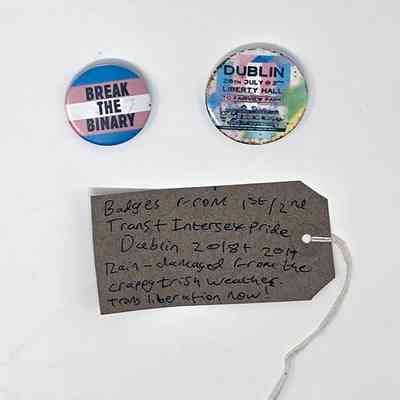
Trans & Intersex Pride Dublin: Badges
MOT000994
Tag Badges from 1st/2nd Trans + Intersex Pride Dublin 2018 + 2019 Rain-damaged from the crappy Irish weather. Trans liberation now!
-
- Collections
- Main Collection, Trans Pride Collective UK & Ireland
- Categories
- Trans Pride Collective UK & Ireland, Badges, Intersex
- Place
- Bishopsgate Institute, London
- Description
- Badges from Trans and Intersex Pride Dublin (x2). Two badges from the first and second Trans and Intersex Pride Dublin donated at the Museum of Transology"s 8th Birthday & Trans Pride UK launch, held at the Triangle LGBTQIA+ Cultural Centre, Deptford, and Bishopsgate Institute (11-12 February 2023). The first badge has a Trans Pride background with "Break the Binary" in black writing. The second badge has the text "Dublin. 28th July @ 2pk, Liberty Hall to Fairview Farm" in black writing on a Trans Pride and multi-colured background. Tag reads "Badges from 1st/2nd Trans + Intersex Pride Dublin, 2018 + 2019. Rain-damaged from crappy Irish weather. Trans liberation now!".
- Dimensions
- Height 2 cm Width 5 cm Depth 5 cm

Tag reading "Badges from 1st/2nd Trans + Intersex Pride Dublin 2018 + 2019 Rain-damaged from the crappy Irish weather. Trans liberation now!" Under the tag are two badges. Badge 1 reads "DUBLIN 28th July @ 2PM LIBERTY HALL TO FAIRVIEW PARK" and has a trans flag design background. Badge 2 reads "BREAK THE BINARY" and has a trans flag background.
-
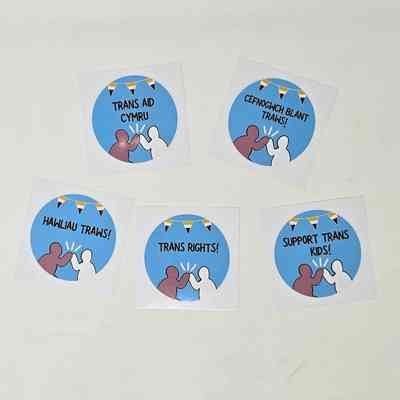
Trans Aid Cymru Stickers, Banner, Prints, Pamphlets and Polaroids
MOT/2024/NDOTC/CARD/023
Tag Tag 1 - one of my favourite badges the Trans Aid Cymru volunteers designed for us to sell at Pride events to fundraise! "veteran of the culture war" sums up so much of how we feel regarding the anti-trans media storms. Tag 2 - the march chants from the 2023 Trans Pride Cardiff march. Hilariously, these were meant to be passed out amongst the crowd but the march stewards didn't manage to pass that message onto the march leaders, so we still have pristine printouts! Tag 3 - the demands from 2022 Trans Pride Cardiff. we wanted these to be easilt shareable on social media, and distributed via a press release to media organisations in september 2022. we are a radical pride, and are unapologetic with our demands. TPC! Tag 4 - a collection of 5 Trans Aid Cymru stickers, in English + Welsh with phrases like "Trans Rights" "Support Trans Kids" "Trans Aid Cymru" Tag 5 - a zibe - Trabsform The Conversation a Welsh/English printed zine designed by trans artists, creatives and actors as part of the "Humanequin" project in 2018/19. I designed the project as an educational resource to assist with sharing the play, and was shared with local schools who come to see the show at the WMC. Tag 6 - a 2nd-edition Trans Aid Cymru leaflet detailing our services, support and resources. Its super colourful and we send these all over Wales too! Tag 7 - our recognisable "Trans in Wales!" You're not alone" QR sticker. These can be found around Wales on many a lamppost offering hope and solidarity in each county! The QR leads you to Trans Aid Cymru's collated resources around surviving the cost of living and trans issues.
-
- Collection
- National Day of Trans Collecting
- Categories
- Trans Pride Collective UK & Ireland, Stickers, Family, Printed Ephemera, Banners
- Place
- Bishopsgate Institute, London
- Description
- Trans aid cymru sticker - non binary flag Trans aid cymru sticker - hawliaw trans! Trans aid cymru sticker - trans rights banner Trans aid cymru sticker - support trans kids Trans aid cymru sticker - cefnogwch blant traws! This object was collected during the Museum of Transology's National Day of Trans Collecting and has been formally acquired by St. Fagans National Museum of History. You can find more about their museum and its collection at: www.museum.wales/stfagans/

Five stickers on a white surface promote trans rights and support.
-
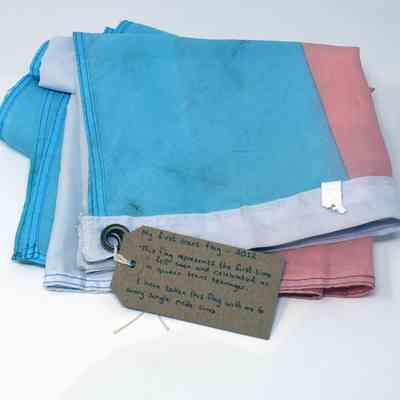
Trans Flag
MOT/2024/NDOTC/CARD/004
Tag My first trans flag – 2012. This flag represents the first time I felt seen and celebrated as a queer trans teenager. I have taken this flag with me to every single pride since.
-
- Collection
- National Day of Trans Collecting
- Categories
- Trans Pride Collective UK & Ireland, Banners
- Place
- Bishopsgate Institute, London
- Description
- This object was collected during the Museum of Transology's National Day of Trans Collecting and has been formally acquired by St. Fagans National Museum of History. You can find more about their museum and its collection at: www.museum.wales/stfagans/
- Dimensions
- Height 1,550 mm Width 88 mm Depth 1 mm

A slightly dirty from use folded up trans flag with a brown tag with writing on it attached.
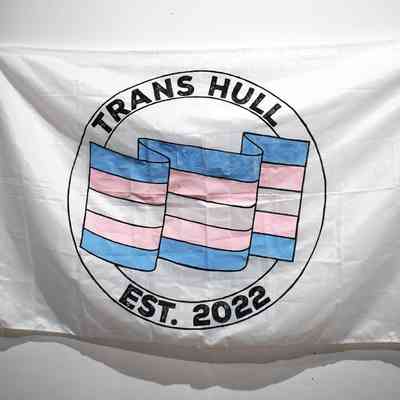
- Trans Hull Banner MOT/2024/TP/HULL/001
-
- Collections
- Trans Pride Collective UK & Ireland, Placard & Banner Collection
- Category
- Trans Pride Collective UK & Ireland
- Place
- Bishopsgate Institute, London
- Dimensions
- Height 920 mm Width 1,550 mm Depth 3 mm

A large white banner with two concentric circles containing the text "TRANS HULL" and "EST. 2022" at the top and bottom. Side the circles is a rippling blue, white and pink trans pride flag