Stories as Objects
stories as objects
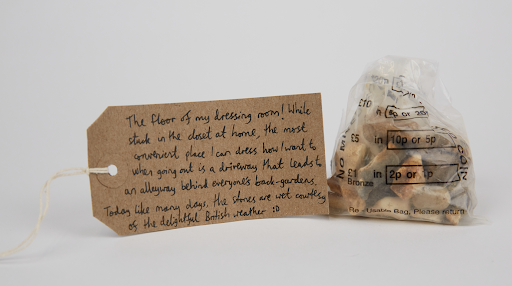
Photo Credit: The Museum of Transology’s Community Photography Collective, Maud Brown, T Edney Harrison, Tass Pett, El Savvas, Henri T, Chloe Bulbrook
The Museum of Transology protects trans voices by treating the handwritten stories attached to donated objects as objects in their own right. When someone donates an item to the collection— a binder, hormone vial, photograph, protest placard or piece of clothing— they are invited to write a short, handwritten message on a brown tag that explains its personal significance. These tags are not treated as labels or curatorial interpretation. They are accessioned into the collection alongside the object they accompany. In this way, the story itself becomes an artefact.
This practice responds to a long history in which trans lives have been recorded through the voices of ‘the oppressor’— through medicine, the media, the law and political debate— rather than in our own words… About us, without us. By accessioning these handwritten testimonies, the Museum of Transology embeds trans voices directly into the material record. The meaning of the object is not mediated by a curator or historian but fixed in the language, handwriting and terms chosen by the person who lived that experience. In this sense, the museum does not simply collect things; it collects voices. In doing so, the Museum of Transology interrupts what I describe as the Authorised Heritage Gender Discourse (AHGD) (an extension of Laurajane Smith’s concept of the Authorised Heritage Discourse) which refers to the ways heritage institutions repeatedly reproduce cis-normative understandings of gender through curatorial authority, classification and interpretation (Smith, 2006).
Once accessioned, these stories enter the governance structures that regulate museum collections. In the UK, objects are not easily removed once they have become part of a museum collection. National museums operate under strict legislation (including the British Museum Act 1963 and the National Heritage Act 1983) that tightly restrict the disposal of accessioned material. While the Museum of Transology is an independent community museum, it operates within the same professional culture of collections governance that treats accessioned objects as part of the permanent historical record. Turning the story into an object therefore has an important archival consequence. The handwritten testimonies are catalogued, preserved and cared for in the same way as any other museum artefact. They become durable evidence of trans lives and experiences rather than temporary commentary or interpretation.
These legal and professional frameworks have famously been invoked to justify the retention of contested colonial collections, familiar examples include the Parthenon Marbles and Benin Bronzes widely across European collections, alongside the deeply troubling histories of human remains held in museum collections. The same colonial museum structures that are today defended through these governance systems also played a significant role in authorising binary understandings of gender. By privileging Western knowledge systems and excluding trans voices from the historical record, museums helped reproduce the idea that gender exists only as a binary sex system. This process was inseparable from the wider colonial project, which imposed Western gender norms across colonised societies and erased diverse cultural expressions of gender beyond the binary— an erasure that occurred both globally and within Britain’s own historical record.
The Museum of Transology therefore turns the logic of institutional authority back on itself. By accessioning the handwritten testimonies of trans donors as objects, their voices become part of the permanent archival record. In doing so, the museum strategically mobilises the same structures of museological permanence that have historically protected imperial collections in order to safeguard trans histories from erasure. The governance systems that once authorised the exclusion of trans lives from the archive are repurposed to ensure that trans people’s own words are permanently written into the historical record.